
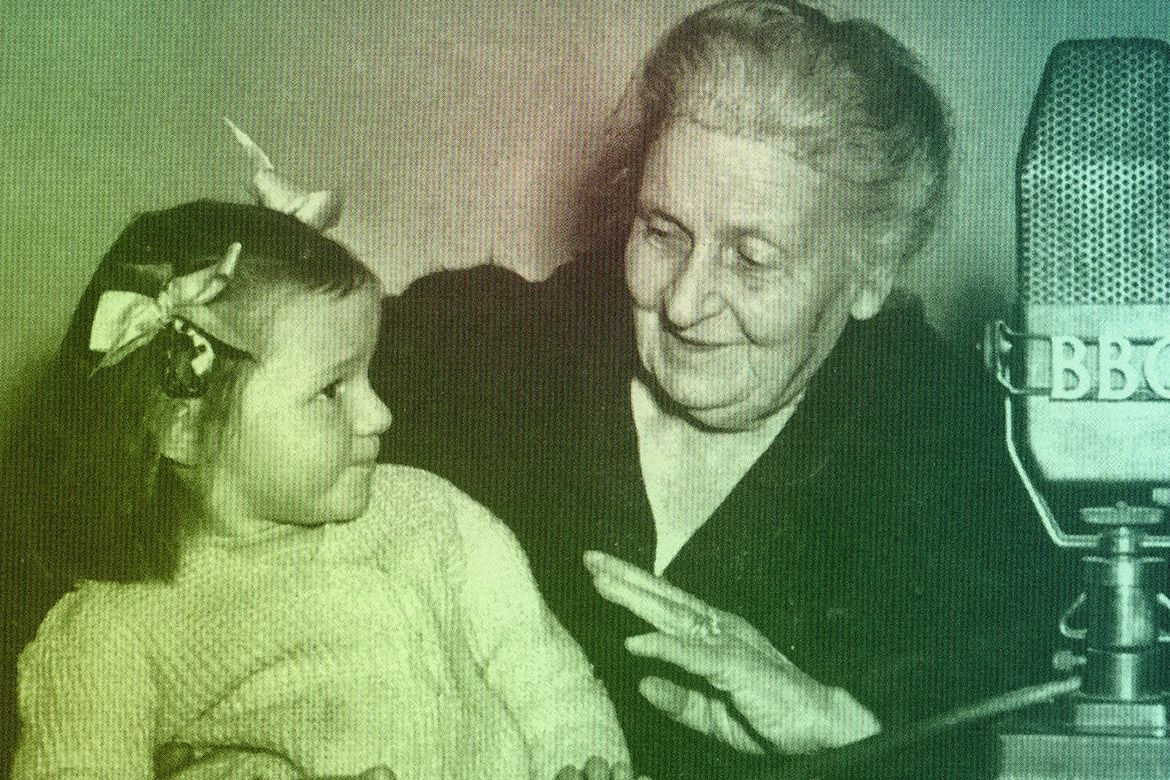
Who was Maria Montessori?
In 1896, at the age of 26, Maria Montessori became one of the first women in Italy to qualify in medicine. She then spent two years at the psychiatric clinic of the University of Rome, studying the behaviour of children who were then labelled “mentally retarded”. There she discovered that these children had nothing at all to play with, even though they needed activity to progress and needed their hands to develop their intelligence. At the same time, she came across the research of Jean Itard (1774-1838), a physician regarded as a founder of otorhinolaryngology who worked with deaf-mute children — notably his writings on Victor, the wild child of Aveyron — and that of Édouard Séguin (1812-1880), a French educator who worked with so-called “idiot” children at Bicêtre. Séguin wrote Hygiène et éducation des idiots, published in 1846, and left France in 1850 to become a doctor in the United States. From 1900, Maria Montessori chose to devote herself to education.
In 1901, she began to take an interest in “ordinary” children and went on to study psychology and philosophy. 1906 was a turning point in her life: she began working with ordinary preschool-age children, for whom she would create her educational method.
The first Children’s House (Casa dei Bambini) opened in 1907 in San Lorenzo, a working-class district of Rome. To improve life in the neighbourhood, a housing organisation had built two apartment blocks to rehouse families from the slums.
Its director asked Maria Montessori to organise the life of the children living in these buildings. The aims were:
- to bring all these children together and keep them from roaming the streets and causing trouble,
- to improve hygiene and foster harmony within families.
Maria Montessori’s key idea is that education is not the transmission of knowledge, but support for the child’s natural development, through a prepared environment suited to the characteristics and needs of their age. Her method is intended as a scientific pedagogy, based on understanding and respecting the laws that govern children’s psychological development.